

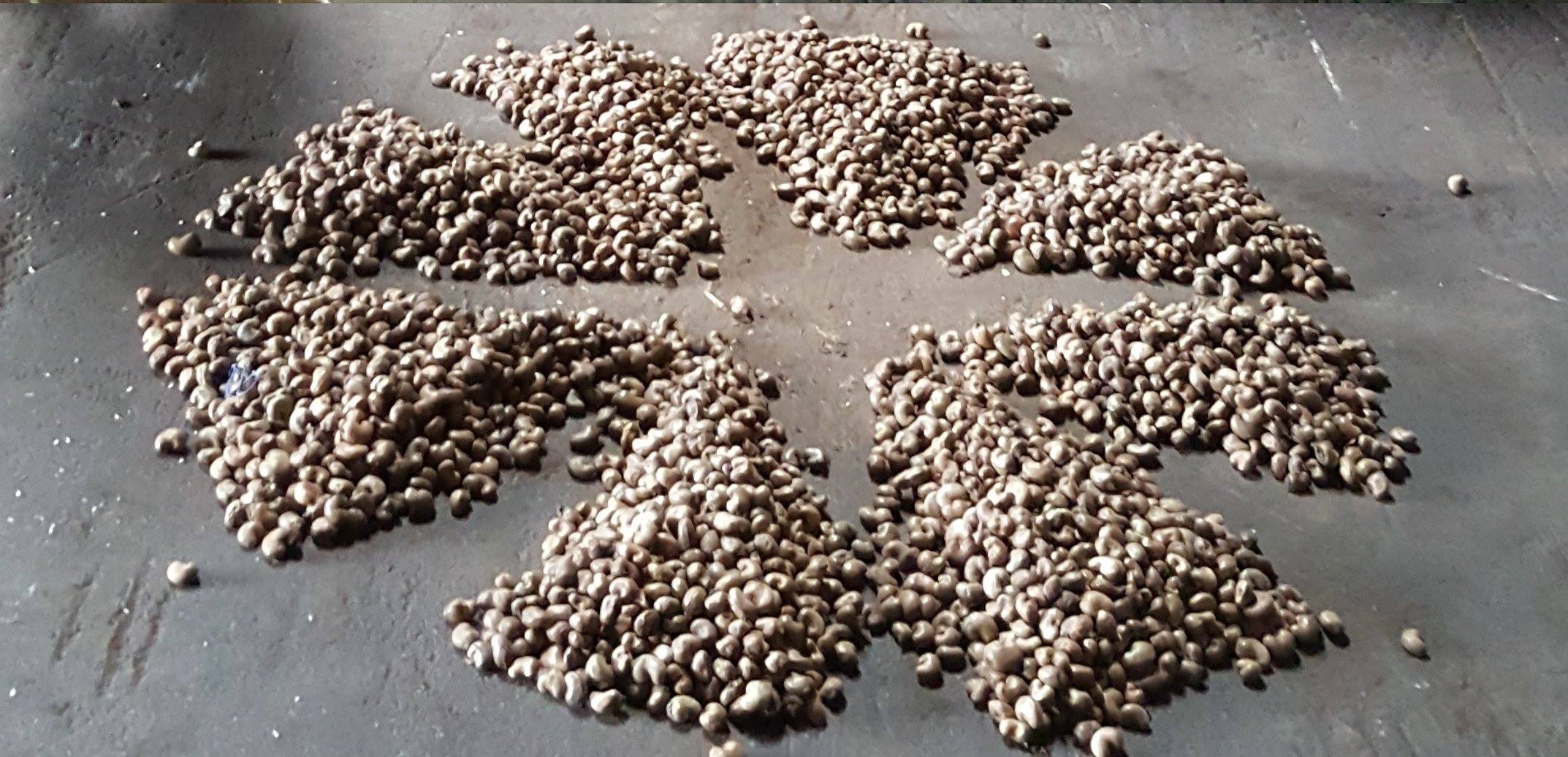
Working directly with established regional cashew procurement centres and cooperatives across West and East Africa.
Trained on-site inspectors conduct random sampling to determine nut count and outturn with zero tolerance for deviation.
Packed in ~80 kg jute bags, stuffed with inline cardboards and moisture bags, fumigated, and weighed at certified weigh bridges.
Raw Cashew Nuts (RCN) are the backbone of the global cashew industry, forming the essential raw material from which all processed cashew products originate. The cashew tree (Anacardium occidentale L.) is native to Eastern Brazil and was introduced to India by the Portuguese nearly five centuries ago. Today, West and East Africa have emerged as the world's most significant cashew-growing regions, contributing the majority of the global RCN supply that feeds processing hubs in India, Vietnam, and beyond.
Commercial cashew cultivation in India began in the early 1960s and has since grown into a high-value, export-oriented commodity. India is today the world's largest cashew processing country, handling approximately 1.59 million tons annually, while Vietnam processes around 0.90 million tons. Both nations rely heavily on African RCN imports to bridge the gap between domestic production and processing capacity - making reliable, quality-focused African suppliers indispensable to the global supply chain.
We have extensive experience in the direct import of Raw Cashew Nuts from key West and East African origins, including Burkina Faso, Togo, Ghana, Ivory Coast, Tanzania, Mozambique, and Indonesia. Our team works directly with established, quality-conscious regional cashew procurement centres and cooperatives across these regions, enabling us to source high-grade crop at competitive prices while maintaining complete traceability from farm to port.
| Country / Region | Production (MT / Year) | Relative Volume |
|---|---|---|
| Ivory Coast | ~900,000 MT | |
| Tanzania | ~200,000 MT | |
| Indonesia | ~160,000 MT | |
| Mozambique | ~130,000 MT | |
| Ghana | ~95,000 MT | |
| Togo | ~90,000 MT | |
| Burkina Faso | ~55,000 MT |
Figure 5 - Approximate annual Raw Cashew Nut production by country of origin
| Origin / Region | Jan | Feb | Mar | Apr | May | Jun | Jul | Aug | Sep | Oct | Nov | Dec |
|---|---|---|---|---|---|---|---|---|---|---|---|---|
| Burkina Faso | – | – | ✓ | ✓ | ✓ | ✓ | – | – | – | – | – | – |
| Togo | – | ✓ | ✓ | ✓ | ✓ | – | – | – | – | – | – | – |
| Ghana | – | ✓ | ✓ | ✓ | ✓ | – | – | – | – | – | – | – |
| Ivory Coast | – | ✓ | ✓ | ✓ | ✓ | ✓ | – | – | – | – | – | – |
| Tanzania | – | – | – | – | – | – | – | – | ✓ | ✓ | ✓ | ✓ |
| Mozambique | ✓ | – | – | – | – | – | – | – | – | – | ✓ | ✓ |
| Indonesia | ✓ | – | – | – | – | – | – | – | – | ✓ | ✓ | ✓ |
Naturally fallen raw cashews with 15-20% moisture are hand-picked by farmers and aggregated at collection points.
Trained on-site inspectors conduct random sampling to determine nut count and outturn, maintaining zero tolerance for quality deviation.
Raw cashews are sun-dried for 1-2 days until moisture levels reduce to 6-8%, ensuring safe storage and transit conditions.
Dried nuts are packed in Jute bags (approx. 80 kg each) and stored in well-ventilated rooms with adequate spacing between stacks to maintain air circulation.
Thoroughly inspected, dry containers are loaded and stuffed with packed jute bags. Inline cardboards and moisture bags are placed to protect quality. Containers are fumigated, sealed, and weighed at a certified weigh bridge before dispatch.
Our experienced clearing agents at African loading ports coordinate with the best shipping lines for timely delivery. All export documentation is handled efficiently upon payment as per agreed terms.
Outturn, nut count, moisture, defective percentage and foreign matter checks. Third-party inspection, quality, and loading certificates are available from SGS, RBS, Cotecna, or any other desired agency upon client request.
Connect with our origin teams in West and East Africa for reliable shipments, verified nut count, and complete traceability.